Pearson Edexcel · GCSE · History
Course version: 1HI0 · Version from Sept 2016
C1900–present: Crime and punishment in modern Britain - 1 Nature and…
Full specification wording
Option 10: c1900–present: Crime and punishment in modern Britain - 1 Nature and changing definitions of criminal activity: Changing definitions of crime, including driving offences, race crimes and drug crimes.
During the 20th and 21st centuries, definitions of crime evolved to reflect changing social attitudes and technology.
Checked against the Pearson Edexcel 1HI0 specification (opens in a new tab) on .
- Point 2 of 2
- 4 key terms
Study notes
From the checked teaching notes for this specification point.
The idea
During the 20th and 21st centuries, definitions of crime evolved to reflect changing social attitudes and technology. Mass ownership of the car led to entirely new driving offences, such as speeding and driving under the influence of alcohol, which was made measurable by the 1967 breathalyser. Changing social values regarding equality resulted in the criminalisation of discrimination and race crimes, notably through the 1968 Race Relations Act. Furthermore, the recreational use of certain substances was redefined as criminal. The 1971 Misuse of Drugs Act classified drugs and made their possession and supply illegal, reflecting growing public health concerns and demonstrating how the law adapts to govern new behaviours in modern British society.
What earns the marks
- Explain how the proliferation of automobiles necessitated new laws, creating driving offences like speeding and drink-driving.
- Describe the impact of the 1967 Road Safety Act and the introduction of the breathalyser on defining and policing drink-driving.
- Analyse how changing social attitudes towards equality led to the creation of race crimes and hate crime legislation, such as the 1968 Race Relations Act.
- Explain the criminalisation of drug use and supply, specifically referencing the 1971 Misuse of Drugs Act.
- Discuss how these changing definitions reflect broader shifts in societal values, public safety concerns, and technological developments.
Common mistakes and how to put them right
Assuming driving offences existed before the 20th century.
Put it right: While horse-drawn vehicles had rules, modern driving offences are a direct result of the invention and mass production of the motor car.
Stating that racism was always a crime.
Put it right: Racial discrimination and race hate crimes were only legally defined as crimes in the UK from the 1960s onwards.
Confusing the smuggling of drugs with the definition of drug crimes.
Put it right: While smuggling is a crime, the 1971 Act specifically defined the possession and supply of certain drugs within the UK as criminal offences.
Exam tips
- Memorise key legislation dates, such as the 1967 Road Safety Act and the 1971 Misuse of Drugs Act, to support your explanations.
- When discussing changing definitions, explicitly state what the new law made illegal that was previously legal or unregulated.
- Link the creation of race crimes to the context of post-war immigration and changing attitudes towards human rights.
Try the lesson
The start of the Option 10: c1900–present: Crime and punishment in modern Britain - 1 Nature and changing definitions of criminal activity: Changing definitions of crime, including driving offences, race crimes and drug crimes. lesson, made from checked teaching notes for this specification point.
Have a go first
Which of the following became a new type of criminal offence during the twentieth century due to technological changes?
Listen
During the 20th and 21st centuries, definitions of crime evolved to reflect changing social attitudes and technology. Mass ownership of the car led to entirely new driving offences, such as speeding and driving under the influence of alcohol, which was made measurable by the 1967 breathalyser. Changing social values regarding equality resulted in the criminalisation of discrimination and race crimes, notably through the 1968 Race Relations Act. Furthermore, the recreational use of certain substances was redefined as criminal. The 1971 Misuse of Drugs Act classified drugs and made their possession and supply illegal, reflecting growing public health concerns and demonstrating how the law adapts to govern new behaviours in modern British society. A strong answer earns marks for these points. Explain how the proliferation of automobiles necessitated new laws, creating driving offences like speeding and drink-driving. Describe the impact of the 1967 Road Safety Act and the introduction of the breathalyser on defining and policing drink-driving. Analyse how changing social attitudes towards equality led to the creation of race crimes and hate crime legislation, such as the 1968 Race Relations Act. Explain the criminalisation of drug use and supply, specifically referencing the 1971 Misuse of Drugs Act. A common slip: Assuming driving offences existed before the 20th century. Instead, while horse-drawn vehicles had rules, modern driving offences are a direct result of the invention and mass production of the motor car. Exam tip: Memorise key legislation dates, such as the 1967 Road Safety Act and the 1971 Misuse of Drugs Act, to support your explanations.
See it
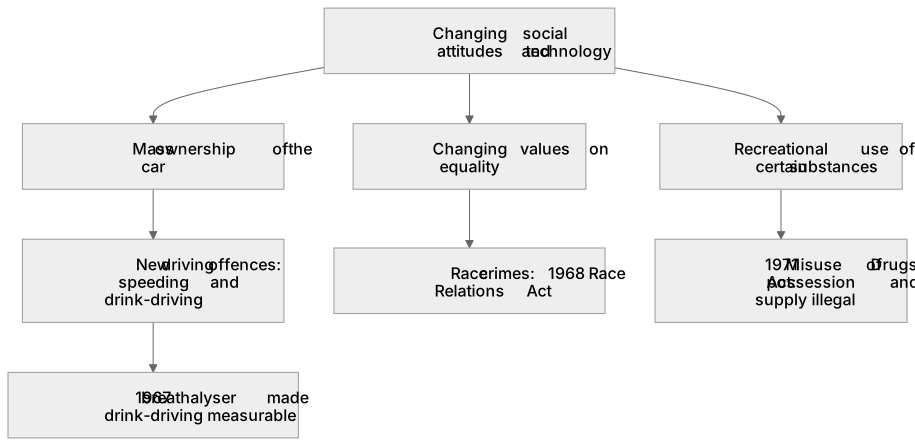
Put the events in order
Put these events in the order they happened, earliest first.
- 1. Road Safety Act introduced the breathalyser for drink-driving
- 2. Misuse of Drugs Act classified drugs and made possession and supply illegal
- 3. Race Relations Act created race crimes
Key words
Say what each word means before you turn the card.
Driving offences
Try answering aloud or in your head before turning the card.
Race crimes
Try answering aloud or in your head before turning the card.
Drug crimes
Try answering aloud or in your head before turning the card.
Changing definitions of crime
Try answering aloud or in your head before turning the card.
See every definition
- Driving offences
- New crimes such as speeding and driving under the influence of alcohol arose from mass ownership of the car.
- Race crimes
- The criminalisation of discrimination and race crimes came about through changing social values regarding equality.
- Drug crimes
- The 1971 Misuse of Drugs Act classified drugs and made their possession and supply illegal.
- Changing definitions of crime
- During the 20th and 21st centuries, definitions of crime evolved to reflect changing social attitudes and technology.
Label the diagram
Some boxes have lost their names. Pick the right name for each number.
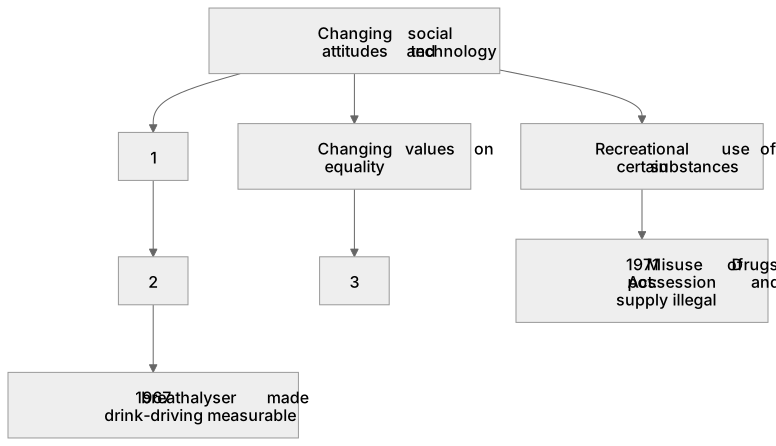
1Box 1
2Box 2
3Box 3
There is more to this lesson
The full lesson goes on to check your understanding and help you earn the marks. Create a free account to carry on, with your progress saved.
A week of Premium from your first lesson · Then the free plan continues · No card, no charge
Test your understanding of Option 10: c1900–present: Crime and punishment in modern Britain - 1 Nature and changing definitions of criminal activity: Changing definitions of crime, including driving offences, race crimes and drug crimes.
Active recall beats re-reading. Take an instant quiz now to test what you’ve learned and lock it into long-term memory.
A week of Premium from your first lesson · Then the free plan continues · No card, no charge